
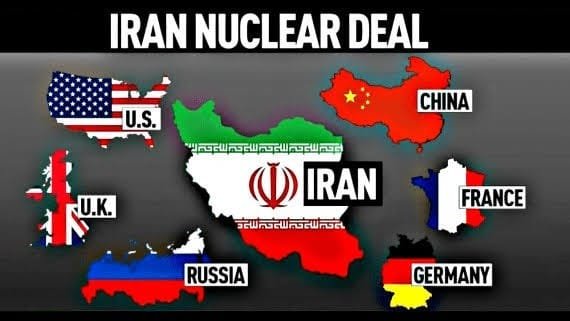
Just so we get this right, the JCPOA is the Joint Comprehensive Plan of Action. It is not a treaty and it is not a UN agreement. It is an international political agreement negotiated between Iran and a group of world powers known as the P5+1, which are the United States, United Kingdom, France, Russia, China, and Germany. What makes it significant is that the UN Security Council Resolution 2231 endorsed the JCPOA in 2015, thus making it part of international law under the UN framework. The JCPOA itself is not legally binding as a treaty; however, it is instead a voluntary agreement where Iran agreed to nuclear restrictions in exchange for sanctions relief. To be very clear, Iran is in direct violation of the JCPOA by all accounts, but who is to hold Iran accountable, for what gain, and will Iran comply?
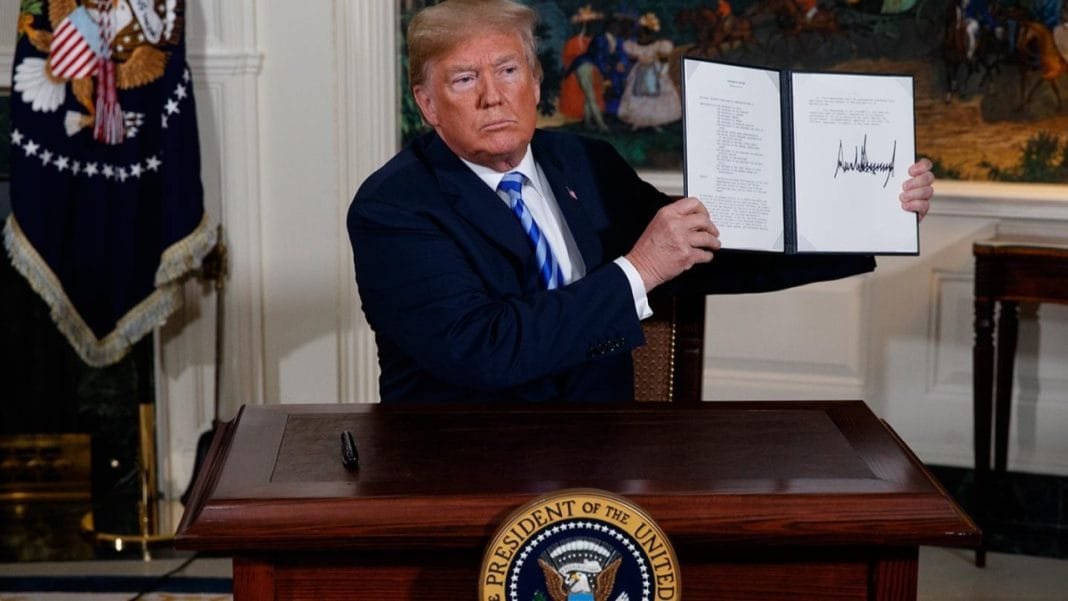
“In theory, the so-called ‘Iran deal’ was supposed to protect the United States and our allies from the lunacy of an Iranian nuclear bomb… In fact, the deal allowed Iran to continue enriching uranium and, over time, reach the brink of a nuclear breakout”(Donald Trump).
Donald Trump, Remarks by President Trump on the Joint Comprehensive Plan of Action, The White House, 8 May 2018.
To further catch you up to speed, the United States is no longer part of the JCPOA as a result of Donald Trump’s first term of office as President of the United States. Now, one might ask why the United States is no longer part of the JCPOA, and it’s because Donald Trump was trying to use a tactic—well, many tactics for that matter—to force Iran to suffer more and renegotiate the terms of the JCPOA to better suit the United States. Donald Trump employed a campaign tactic dubbed “maximum pressure,” imposing unilateral sanctions on Iran to force renegotiation of the JCPOA terms. The whole entire point of the JCPOA was to lift all of the sanctions that were on Iran in exchange for Iran to cease its pursuit of nuclear development. Under Trump’s plan, he imposed sanctions against Iran and threatened any country that continued to trade with Iran. By the U.S. exiting the JCPOA, it forfeited its legal right to what’s called ‘Snapbacks‘ – which is, at its simplest, the reverting to sanctions that were previously imposed by the United Nations against Iran. Since the JCPOA halted the sanctions that were on Iran, if they were found to be in violation of the JCPOA, the member states P5+1 would have legal rights to impose snapback mechanisms to reinstate previously lifted UN sanctions.
Now where does the UN Security Council members’ veto power come into play? Well, in the shortest terms, it doesn’t and wouldn’t. This is because the way that the JCPOA was written is so that even in the most extreme circumstance, if an allied member state to Iran exercises its right to veto power, it is overridden by the JCPOA, making it impossible to stop the snapback from occurring in 30 days. This is because any resolution to stop the sanctions can be vetoed by the party that triggered the snapback. To answer the question of who is to hold Iran accountable as it stands right now, it is the remaining member states in the JCPOA. Now, enforcing the compliance of the snapback is another story. The UN itself doesn’t have a policing agency to enforce compliance. It’s up to the member states within the United Nations to abide by, in this instance, the snapback. Iran could ignore and look the other way, or China and Russia, for that matter, who have strong ties with Iran, could ignore it as well. One tactic would be secondary sanctions for non-compliance with the snapbacks that other member states could impose upon Iran.
What did Iran do to be called out by the E3 (France, Germany, and the U.K.)? Under the JCPOA, we know that its main goal is to deter Iran from developing any nuclear weapons capability at its core. Thus, one has to understand what makes a nuclear weapon. Nuclear weapons are made from enriched uranium of greater than or equal to 90%. When one says the term “enriched” when speaking about uranium, they are referring to the isotopes found within uranium. The three main isotopes of uranium are U-238, U-235, and U-234. U-238 makes up 99.3% of natural uranium, which is the majority of the element. U-238 is very stable but non-fissile, which means it cannot sustain a chain reaction on its own. What it is used for sometimes is armor-piercing ammunition or radiation shielding due to its density. It can also be used in breeder reactors to produce plutonium-239, which is fissile and used in nuclear reactors or weapons. Now the one that really matters is U-235. U-235 only makes up 0.7% of natural uranium, so it is a very low amount. This isotope is fissile, meaning it can split (fission) when struck by a neutron, releasing energy in the process. Its uses are nuclear fuel for civilian power reactors when enriched to 3-5% normally. However, when it is enriched to 90% or higher, that is what is known as weapons-grade material to make a nuclear weapon possible. Since U-235 naturally occurs at 0.7%, it must be enriched. To do this, it essentially is separated from the other naturally occurring isotopes. Given that U-235 has a different density than U-238 and U-234, it can be spun in a centrifuge and separated out. The more that is collected, the higher the content of U-235 there can be. Under the JCPOA, the maximum allotted amount of U-235 that Iran may enrich to is 3.67%, which is sufficient for energy. The maximum stockpile of enriched uranium that Iran may possess is capped at 300kg (661.39 lbs). Iran has ignored the JCPOA and enriched to 60% purity. That is 56.33% higher than what they signed for and points in only one direction.
“U.N. Secretary-General Antonio Guterres submitted his biannual report to the Security Council on the implementation of the 2015 resolution on Tuesday, warning there was a “critical need for a peaceful solution to the Iranian nuclear issue” given the deteriorating situation across the Middle East”(Nichols).
The body that is in charge of keeping tabs on details like this is called the International Atomic Energy Agency (IAEA). Under the JCPOA, the IAEA is granted access to declared facilities with advance notice for routine inspections. Additionally, under the Additional Protocol, the IAEA can request short-notice inspections—typically with 24 hours’ notice—at sites where undeclared activity is suspected. However, this access requires Iran’s cooperation, and the JCPOA does not explicitly grant automatic access to military or undeclared facilities. This creates delays and enforcement challenges. Now the great question that is coming up in the UN is will Iran comply? The EU3 want to move toward snapbacks as the evidence shows Iran busted the 3.67% limit set forth with the JCPOA, which they signed. There is no credible reason for Iran to require 60% purity, as civilian reactors operate with uranium enriched to only 3%-5%. They are just 30% away from reaching nuclear weapons-grade enriched U-235. Now couple that with the man-made substance plutonium-239. This is made as a byproduct of U-238, the most commonly found isotope in uranium, by irradiating U-238 in a nuclear reactor. Plutonium-239 was a key material used in the development of the atomic bomb during World War II. Specifically, it was the fissile material in the “Fat Man” bomb that was dropped on Nagasaki, Japan, in 1945. Pu-239 is highly fissile, meaning it can sustain a rapid chain reaction, releasing an immense amount of energy in a short time. Its production and use demonstrate why its presence raises significant concerns regarding nuclear weapons development.
“Britain, France and Germany told the Security Council in a letter earlier this month that they are ready – if needed – to trigger a so-called “snap back” of all international sanctions on Iran to prevent the country from acquiring a nuclear weapon”(Nichols).
Now we know that the only enforcements currently under the JCPOA are the IAEA, snapbacks, and unilateral sanctions by the U.S. However, what should have been put into place to combat the weak points of the JCPOA before signing would have been an automatic enforcement mechanism of snapbacks. As soon as Iran busts the allotted enriched percentages or stockpile amounts, snapbacks would automatically be enforced with tighter deadlines for compliance. Broader IAEA inspection powers would have granted the IAEA unrestricted access to all declared, undeclared, and military sites on short notice. There were not fully formed clauses within the JCPOA that addressed the regional instability of Iran’s ballistic missile programs. Iran’s ballistic missile program poses a significant regional and global security threat, as these missiles are widely seen as capable of delivering nuclear warheads, particularly given ongoing advancements in range and precision. While the JCPOA focused solely on uranium enrichment and nuclear stockpiles, it failed to address Iran’s development, testing, and deployment of medium- and long-range ballistic missiles, which are capable of reaching neighboring countries and even parts of Europe. Iran has continued to develop missiles with greater precision and range, such as the Shahab-3 and Khorramshahr, which are widely believed to have dual-use potential for conventional and nuclear payloads. This omission in the JCPOA has contributed to ongoing instability in the Middle East, where countries like Saudi Arabia, Israel, and the United Arab Emirates perceive Iran’s missile advancements as a direct threat to their national security. Addressing this issue before signing the agreement could have included strict limitations on missile development, mandatory transparency measures, and cooperation with international arms control bodies. Lastly, an enforcement body within the IAEA or UN to specifically oversee compliance and penalties—leaving out political interference, making it cut and dry.
Was Donald Trump right or wrong? He was right to question the JCPOA as it’s very evident that the results we are now faced with at 60% is a far cry from 3.67% enriched U-235. As we speak, snapbacks are still not being enforced even though the UN knows the facts. Diplomacy has shrouded the landscape within the walls of the UN, between backpedaling and accelerating, with all tracks of diplomacy at work from all sides. However, Donald Trump was severely wrong for withdrawing from the JCPOA, as his “maximum pressure” tactic failed miserably. He put distrust in all U.S. allies, namely the EU3, who are currently still in the JCPOA. How could the U.S. be trusted under his administration not to just back out, rather than reworking the JCPOA before being signed? When it comes to Donald Trump and the United Nations, he makes very ill-informed and hasty decisions that impact more than the 346 million people in the U.S. – it also impacts the 1.1 billion people in allied member states to the United States. Refer to my Veterans Day special article on his actions when it comes to U.S. Ambassadors.
Works Cited
- Trump, Donald. “Remarks on the Joint Comprehensive Plan of Action.” The White House, 8 May 2018, https://www.govinfo.gov/content/pkg/DCPD-201800310/pdf/DCPD-201800310.pdf. Accessed 18 Dec. 2024.
- “The Manhattan Project.” U.S. Department of Energy, https://www.energy.gov/manhattan-project. Accessed 18 Dec. 2024.
- “2020 Ballistic and Cruise Missile Threat.” U.S. Department of Defense, 11 Jan. 2021, https://media.defense.gov/2021/Jan/11/2002563190/-1/-1/1/2020%20BALLISTIC%20AND%20CRUISE%20MISSILE%20THREAT_FINAL_2OCT_REDUCEDFILE.PDF. Accessed 18 Dec. 2024.
- “Verification and Monitoring in Iran.” International Atomic Energy Agency, https://www.iaea.org/newscenter/focus/iran. Accessed 18 Dec. 2024.
- “Resolution 2231 (2015) on Iran Nuclear Issue.” United Nations Security Council, https://www.un.org/securitycouncil/content/2231/background. Accessed 18 Dec. 2024.
- “Missiles of Iran.” Center for Strategic and International Studies, 10 Aug. 2021, https://missilethreat.csis.org/country/iran/. Accessed 18 Dec. 2024.
- Nichols, Michelle. “Europeans Tell UN Ready to ‘Snap Back’ Iran Sanctions if Needed.” Reuters, 11 Dec. 2024, https://www.reuters.com/world/europeans-tell-un-ready-snap-back-iran-sanctions-if-needed-2024-12-11/. Accessed 18 Dec. 2024.
- Nichols, Michelle. “UN Pushes for Iran Nuclear Deal Talks, Says ‘Time of the Essence’.” Reuters, 17 Dec. 2024, https://www.reuters.com/world/un-pushes-iran-nuclear-deal-talks-says-time-essence-2024-12-17/. Accessed 18 Dec. 2024.
- “Countries Involved in the Iran Nuclear Deal (JCPOA).” Image Source: Samajho, Reviving the Joint Comprehensive Plan of Action (JCPOA), https://samajho.com/upsc/reviving-the-joint-comprehensive-plan-of-action-jcpoa/. Accessed 18 Dec. 2024.
- “Trump Speaks on JCPOA Withdrawal.” The Nation, https://www.thenation.com/article/archive/trumps-unwavering-adversary-islam/. Accessed 18 Dec. 2024.
What is the JCPOA and why does it matter?
The JCPOA, or Iran nuclear deal, limited Iran’s uranium enrichment in exchange for sanctions relief. Its collapse reshaped nuclear diplomacy worldwide.
How much uranium is Iran enriching now?
Iran is enriching uranium to 60%, far beyond the 3.67% JCPOA limit, bringing it closer to weapons-grade levels.
What are snapback sanctions?
Snapbacks are automatic UN sanctions reinstated if Iran violates the JCPOA. Enforcement has stalled due to political gridlock.
Why did Trump leave the JCPOA?
Trump exited the JCPOA to force a renegotiation favoring the U.S., but it fractured international trust and weakened enforcement mechanisms.
Backstory:
To understand Iran’s drive for nuclear capabilities and the JCPOA’s complexities, it’s vital to examine decades of geopolitical friction and regional tensions. In 1953, the CIA-backed coup against Iranian Prime Minister Mohammad Mossadegh—who had nationalized Iran’s oil—set the stage for enduring mistrust toward the West, especially the United States and Britain. The ensuing rule of Shah Mohammad Reza Pahlavi, supported heavily by Western powers, ended with the 1979 Islamic Revolution, ushering in an anti-Western regime deeply wary of foreign interference.
Following the revolution, relations worsened dramatically when Iran held 52 American diplomats hostage for 444 days (1979–1981), cementing mutual hostility. In the decades since, Iran’s regional adversaries—primarily Saudi Arabia and Israel—backed by U.S. support, created a security dilemma for Iran. Tehran increasingly viewed nuclear capability as essential for national security, deterrence, and geopolitical leverage, particularly amid fears of regime-change efforts from external powers, exemplified by the U.S. invasions of neighboring Iraq and Afghanistan.
These tensions culminated in years of economic sanctions by Western countries designed to weaken Iran’s nuclear ambitions. The JCPOA emerged in 2015 as an attempt to ease this standoff—offering Iran sanctions relief in exchange for verified limitations on its nuclear activities. However, Iran’s historical skepticism toward Western commitments persisted. When President Trump withdrew from the JCPOA in 2018, reinstating severe sanctions under a “maximum pressure” policy, Iranian leaders felt betrayed once again, fueling their willingness to openly breach enrichment limits to regain strategic leverage.
Understanding this historical context—the cycle of mistrust, geopolitical rivalry, and Iran’s persistent security fears—clarifies not just why Iran pursued nuclear capabilities, but why the JCPOA’s delicate compromise unraveled so quickly.
Connection to Present Article:
Iran enriching uranium to 60%, far exceeding the agreed limit of 3.67%, underscores the JCPOA’s inherent vulnerabilities. President Trump’s withdrawal from the agreement and the subsequent U.S. “maximum pressure” campaign disrupted international consensus, creating conditions that allowed Iran to test and violate the limits of the agreement without immediate repercussions, leading to today’s nuclear tensions.
Concepts:
(Click each term for full definitions in the Allwin Advantage Library → Concepts)
JCPOA: The 2015 diplomatic agreement aimed at limiting Iran’s nuclear capabilities in exchange for sanctions relief.
UN Security Council Resolution 2231: UN resolution endorsing the JCPOA, integrating it into international legal frameworks.
Snapback Sanctions: Automatic reinstatement of suspended sanctions triggered if Iran breaches JCPOA terms.
Reverse Veto: Mechanism allowing initiating states to override other nations’ vetoes, ensuring snapback sanctions occur.
IAEA Additional Protocol: An enhanced nuclear-inspection protocol providing inspectors rapid access to suspect sites.
Ballistic Missile Gap: The JCPOA’s critical omission of constraints on Iran’s ballistic missile capabilities.
Breakout Time: Duration required for a nation to accumulate sufficient weapons-grade uranium to build a nuclear weapon.
Compliance-Enforcement Gap: The structural weakness of lacking a neutral authority capable of enforcing JCPOA compliance.
Strategies:
(Click each strategy for full definitions in the Allwin Advantage Library → Strategies)
Maximum Pressure: U.S. strategy of using extensive unilateral sanctions to force a renegotiation of the JCPOA.
Secondary Sanctions: Sanctions applied by one country on third-party nations or businesses continuing transactions with sanctioned entities.
Sovereign Leverage: Nations strategically using nuclear advancement to gain diplomatic or economic bargaining power.
Dual-Use Dilemma: Managing technology usable for both peaceful civilian purposes and military applications, complicating enforcement.