

Table of Contents
Hungary LGBTQ Amendment
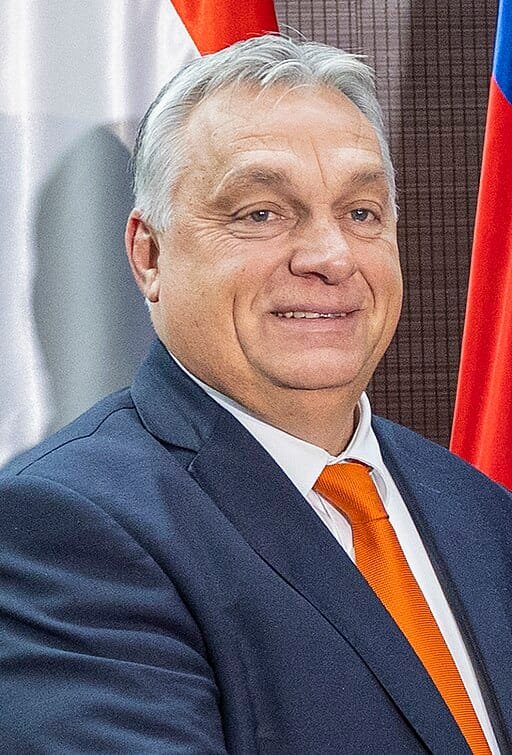
On April 14th, 2025, Hungary constitutionalized discrimination by amending their constitution to namely discriminate against the LGBTQIA+ community. The LGBTQIA+ community, known worldwide to celebrate their je ne sais quoi by education, public displays of celebration, and happiness, is now legally restricted in its ability to educate, gather publicly, or express itself freely in Hungary. The Fidesz party, led by Prime Minister Viktor Orbán, has sparked international concern by blatantly constitutionalizing discrimination—despite public backlash, the well-being of its own constituents, and the long-term consequences for both Hungary and the world.
Article 2 – Binary Gender
“A person is either male or female. The mother is a woman, the father is a man”(“Fifteenth Amendment,” Article 2).
Click for Original Hungarian:
„Az ember férfi vagy nő. Az anya nő, az apa férfi”(„Magyarország Alaptörvényének tizenötödik módosítása”, 2. cikk)
This enshrines a binary definition of gender into Hungary’s constitution, affirming that only two sexes exist and framing family structures strictly through heterosexual roles. According to IPSOS, a global market research company, 4% of Hungary’s 9.6 million residents identify as part of the LGBTQIA+ community. That’s at least 384,000 people—without accounting for those who do not openly identify. The European Union Agency for Fundamental Rights (FRA) reported in 2023 that only 32% of LGBTQIA+ individuals in Hungary are “often” or “always” open about their identity. This means roughly 68% of people who are part of the LGBTQIA+ community in Hungary actively hide it (Telex; European Union Agency for Fundamental Rights 3).
Article 4 – Child Protection Above All
“Every child has the right to protection and care necessary for their appropriate physical, mental, and moral development. This right — with the exception of the right to life — takes precedence over all other fundamental rights. Hungary protects the right of children to an identity corresponding to their birth sex, and ensures education in accordance with the values based on Hungary’s constitutional identity and Christian culture”(Magyar Közlöny).
Click for Original Hungarian
„Minden gyermeknek joga van a megfelelő testi, szellemi és erkölcsi fejlődéséhez szükséges védelemhez és gondoskodáshoz. Ez a jog – az élethez való jog kivételével – minden más alapvető jogot megelőz. Magyarország védi a gyermekek születési nemének megfelelő önazonossághoz való jogát, és biztosítja a hazánk alkotmányos önazonosságán és keresztény kultúráján alapuló értékrend szerinti nevelést”(Magyar Közlöny).
Article 4 puts children at the forefront, declaring that their moral development must be protected above all else. These protections could come at a cost—a cost in social trust, mental health, educational freedom, and international credibility—that Hungary may not be prepared to afford. There are arguments on every side of a double-sided coin; however, to Hungary, that coin has only two faces: Male or Female. Hungary has aimed to—and succeeded in—preventing or criminalizing early transitions for adolescents. This also extends to any education around the topic of gender identity or sexual orientation, should the government choose to enforce it. It remains unclear who the monitoring agency would be, as there cannot be a representative in every classroom, afterschool program, or youth service space. The enforcement ambiguity alone could result in overcorrection, self-censorship, and a chilling effect across the educational system. Hungary still records more deaths than births—about 352 deaths versus 231 births per day in 2025—so its rising generation is shrinking even as its social weight grows” (World Population Review, 2025). The decisions made today will not only shape future laws; they will define what it means to grow up Hungarian.
Other Articles in the Amendment
While Article 2 and Article 4 directly target the LGBTQIA+ community, several other amendments quietly expand the government’s legal reach.
- Article 1 – Authorizes the temporary suspension of citizenship for dual nationals under cardinal law (EU citizens exempt).
- Article 3 – Enshrines the right to use cash in an increasingly digital economy.
- Article 5 – Bans the production, use, distribution, and promotion of narcotics.
- Article 6 – Allows restrictions on free movement to protect a community’s “local identity,” a term so vague it invites selective enforcement.
- Article 8 – Widens emergency powers, enabling the government—with parliamentary approval—to suspend existing laws during a declared state of danger.
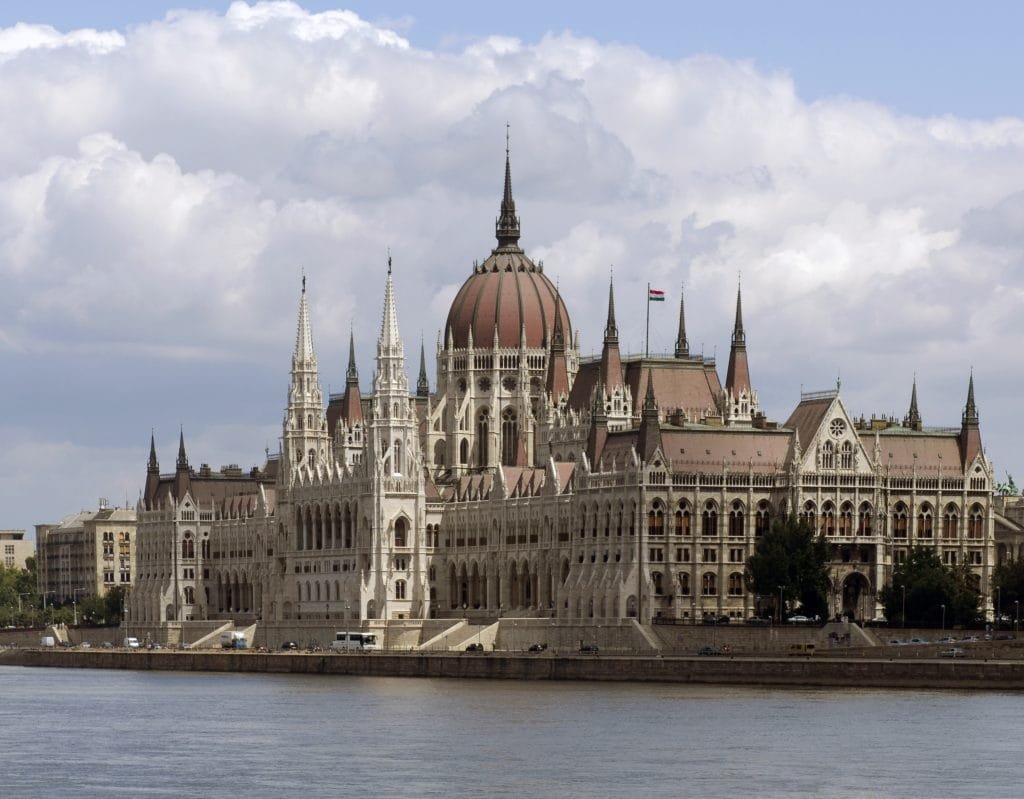
Andrew Shiva / Wikipedia / CC BY-SA 4.0
Backlash
The constitutional amendment has kicked open a political hornet’s nest. In the coming months, Hungary may see a wave of demonstrations that shift Pride away from celebration and toward protest—similar to when Planned Parenthood took over NYC Pride to spotlight abortion rights. Silencing the voices of hundreds of thousands of LGBTQIA+ Hungarians not only threatens civic stability but also puts pressure on Hungary’s GDP, which is heavily supported by international tourism. If the country is no longer perceived as safe for LGBTQIA+ travelers and their allies, that shift in perception could drive down visitation and revenue across hospitality sectors. These economic consequences may ripple outward, impacting investor confidence and international trade as global partners reconsider their relationships with Hungary.
Well-Being
The impact of this constitutional amendment extends far beyond political messaging. It places direct consequences on anyone in Hungary who openly identifies as part of the LGBTQIA+ community. According to the European Union Agency for Fundamental Rights, “34% of respondents in Hungary experienced a so-called ‘conversion’ practice in order to make them change their sexual orientation and/or gender identity. For the EU-27 it is 24%” (European Union Agency for Fundamental Rights 3). Additionally, 57% report being harassed, 39% avoid certain locations out of fear of assault, and 40% have faced discrimination in at least one area of daily life—all before these new constitutional amendments were passed.
Children and adolescents are cited as the justification for Article 4, yet the numbers tell a different story. In Hungary, 69% of LGBTQIA+ students reported bullying, ridicule, or threats while in school. If lawmakers truly center their agenda around protecting youth, these rates should be low—not among the highest in the EU. Over half of LGBTQIA+ students—56%—say they hid their identity, and 68% say they never received any education on LGBTQIA+ topics. These statistics reveal a disconnect between what the law claims to protect and who it actually leaves behind.
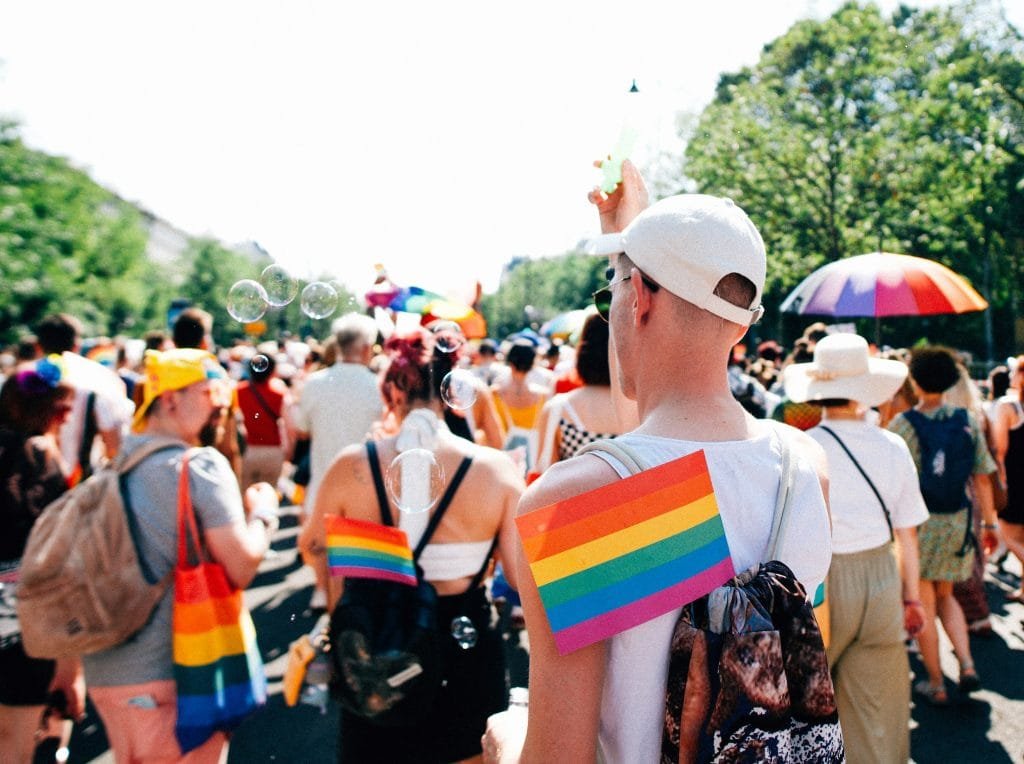
Photo by Christian Lue on Unsplash
Impact
The long-term consequences of Hungary’s constitutional amendments may reach far beyond national borders. Article 6 allows the government to limit free movement in order to protect a community’s “local identity”—a vague phrase that can be used to exclude LGBTQIA+ individuals from renting property, operating businesses, or running clinics if they are deemed inconsistent with regional values. This kind of language gives local governments permission to quietly push people out of public life without ever having to write the word “ban.” Permits, registrations, and residency rights can all be denied under the guise of community preservation.
In the past, Hungary used legal frameworks to isolate Jewish communities into ghettos or deport them to concentration camps. Holocaust historian Randolph L. Braham describes Hungary’s 1938‑41 anti‑Jewish decrees as the creation of a “legal ghetto long before barbed wire appeared” (Braham 142). The Fifteenth Amendment risks building a similar legal perimeter around LGBTQIA+ people: confinement not by fences, but by statutes that local officials can wield at will. Should other nationalist governments copy the model, constitutional law worldwide could tilt from universal rights toward doctrine filtered through selective readings of religious texts. The danger now is that LGBTQIA+ individuals may once again be confined—this time not by fences, but by law.
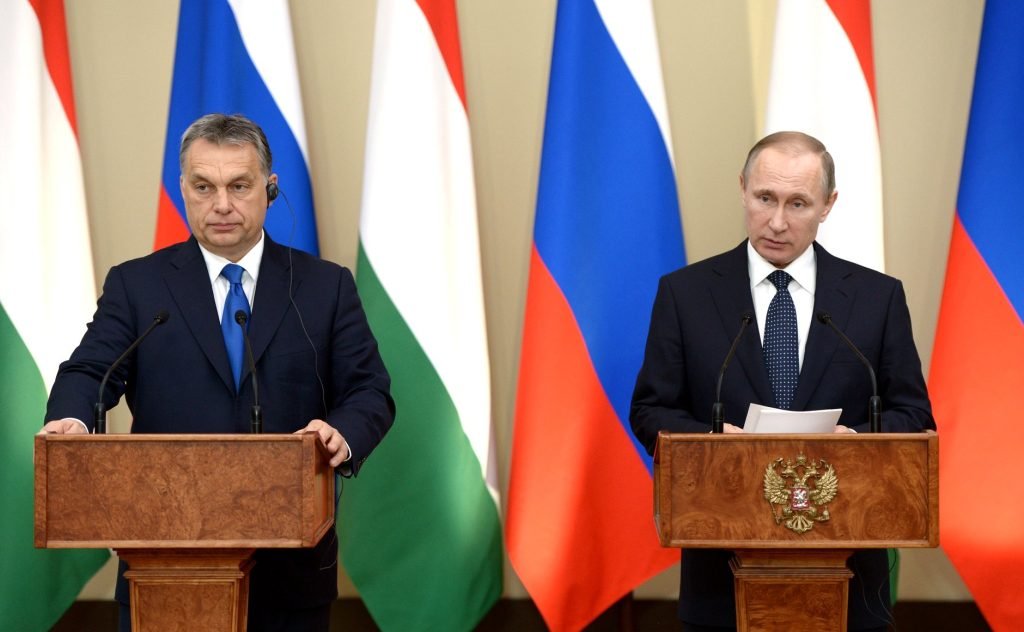
Kremlin.ru, CC BY 4.0 https://creativecommons.org/licenses/by/4.0, via Wikimedia Commons
Works Cited
Braham, Randolph L. The Politics of Genocide: The Holocaust in Hungary. 2nd ed., Wayne State University Press, 2000. Project MUSE, https://muse.jhu.edu/book/6259
Council of Europe, Venice Commission. Opinion No. 1020/2021: On the Compatibility of Hungary’s Child Protection Act with European Standards. Strasbourg, 2021, https://venice.coe.int/webforms/documents/?pdf=CDL-AD(2021)040-e
European Union Agency for Fundamental Rights. LGBTI Survey Country Data — Hungary. 2023, https://fra.europa.eu/sites/default/files/fra_uploads/fra-2023-lgbti-survey-country-data-hungary_en.pdf
Fritz, Zsuzsanna. “Legal and Administrative Instruments of Ghettoization in Hungary.” Hungarian Historical Review, vol. 4, no. 2, 2015, pp. 137–160, https://hunghist.org/images/HHR_2015_2/Fritz.pdf
Fundamental Law of Hungary. Adopted 2011, effective 2012, https://njt.hu/translation/TheFundamentalLawofHungary_20201223_FIN.pdf
Ipsos. “LGBT+ Pride 2024 Global Survey.” Ipsos Global Advisor, 2024, https://www.ipsos.com/sites/default/files/ct/news/documents/2024-06/ipsos-global-pride-2024-report.pdf
Office of the United Nations High Commissioner for Human Rights (OHCHR). “Concern at Hungary’s New Anti‑LGBTIQ+ Law.” Press release, 18 Mar. 2025, https://www.ohchr.org/en/press-releases/2025/03/concern-hungarys-new-anti-lgbtiq-law.
Magyar Közlöny. “Magyarország Alaptörvényének Tizenötödik Módosítása [Fifteenth Amendment to the Fundamental Law of Hungary].” Magyar Közlöny, 15 Apr. 2025, https://magyarkozlony.hu/dokumentumok/3d2d2cfe83a301da3b123bde0c8e3e8f9a46aef4/letoltes
Telex. “Hungarian Parliament Passes Amendment Banning LGBTQ Pride Gatherings.” Telex, 18 Mar. 2025, https://telex.hu/english/2025/03/18/hungarian-parliament-passes-amendment-banning-lgbtq-pride-gatherings
United States Holocaust Memorial Museum. “The Holocaust in Hungary.” Holocaust Encyclopedia, United States Holocaust Memorial Museum, https://encyclopedia.ushmm.org/content/en/article/hungary-after-the-german-occupation. Accessed 17 Apr. 2025
World Population Review. “Hungary Population 2025 (Live).” World Population Review, 2025, https://worldpopulationreview.com/countries/hungary-population
World Population Review. “LGBTQ Population by Country.” World Population Review, 2024, https://worldpopulationreview.com/country-rankings/lgbtq-population-by-country
The Allwin Advantage™

Why did Hungary rewrite its constitution to include gender and morality?
To legally elevate “traditional values” above personal rights — especially around gender, sexuality, and education. The 15th Amendment prioritizes “moral development” and “birth sex identity” over freedom of expression, privacy, and even movement.
How does the amendment limit LGBTQ rights in everyday life?
It can restrict classroom discussions of gender, ban public gatherings that “promote homosexuality,” deny legal recognition of transgender identities, and let local authorities block permits or housing if someone is deemed inconsistent with “local identity.”
What has been the United Nations’ reaction to Hungary’s LGBTQ Amendment?
UN human‑rights bodies—including the Office of the High Commissioner for Human Rights (OHCHR) and independent Special Rapporteurs—have expressed concern that the amendment violates Hungary’s obligations under the International Covenant on Civil and Political Rights (ICCPR) and the Convention on the Rights of the Child (CRC). They urge Hungary to repeal the discriminatory clauses and will likely raise the issue in Hungary’s next Universal Periodic Review at the UN Human Rights Council.
Backstory
Since 2010, Prime Minister Viktor Orbán and his Fidesz party have worked to centralize power and reposition Hungary as an “illiberal democracy.” In 2012, they rewrote the Constitution to define marriage as the union between one man and one woman, legally excluding same-sex couples from marriage, family rights, and later, adoption (Fundamental Law of Hungary, 2012; European Union Agency for Fundamental Rights). In 2020, the government eliminated legal gender recognition, and by 2021, it had passed a so-called “Child Protection Law” banning content that “promotes homosexuality or gender transition” to minors—language so vague, legal scholars warned it could criminalize LGBTQIA+ visibility entirely (Council of Europe, Venice Commission, 2021).
But rather than scale back, the government escalated. On March 18, 2025, Hungary amended its Freedom of Assembly Act to ban public gatherings that “promote or display any deviation from a person’s gender at birth, as well as gender reassignment and homosexuality” (Telex). Just weeks later, the 15th Constitutional Amendment, passed on April 14, 2025, enshrined binary gender, birth-sex identity, and Christian-based morality as superior to all other rights—except the right to life (Magyar Közlöny, Article 4). One bans the act. The other legitimizes the reason.

This layered legal strategy echoes Hungary’s history of using law to isolate and erase minority groups. In the 1930s and ’40s, the government passed a series of anti-Jewish laws framed as measures to protect Hungarian identity. The Third Jewish Law (Act XV of 1941) explicitly criminalized intermarriage and sexual relations between Jews and non-Jews, citing the need to preserve the “racial purity of the Hungarian nation” (Hungarian Government Archive; United States Holocaust Memorial Museum). Earlier laws had already redefined Jewishness as a racial category and banned Jewish participation in key professions. By 1944, the state legally mandated yellow star identification, created ghettos, and deported over 437,000 Jews to Auschwitz in just eight weeks—all under the guise of protecting Hungary’s cultural and national integrity.
Then, it was “racial purity.” Today, it’s “moral development.” Just as past laws masked bigotry behind the language of protection and identity, today’s legal framework invokes child safety, Christian values, and constitutional order to marginalize LGBTQIA+ people. With both constitutional and statutory mechanisms in place, Hungary now has the legal tools to ban Pride, suppress LGBTQIA+ organizations, and define who belongs—not just socially, but legally.
How it connects to this article:
This article documents how Hungary’s 15th Constitutional Amendment doesn’t simply change policy — it reshapes rights themselves. The law doesn’t have to say “LGBTQIA+” — it only needs to define “normal.”
Key Legal Concepts Behind the Law
Pretextual Legislation
Discriminatory intent is hidden behind legal justifications like “child protection,” mirroring a historic pattern of state-sponsored exclusion masked as social good.
Supremacy of Constitutional Values
Moral development and Christian values are now legally elevated over civil liberties — meaning free speech and expression can be lawfully restricted in the name of “protecting children.”
Substantive Constitutional Identity Doctrine
Hungary’s legal framework defines its national identity in religious and cultural terms, making it a filter through which all law is interpreted — and dissenting identities excluded.
Vagueness Doctrine and Chilling Effect
Undefined terms like “promotes homosexuality” enable arbitrary enforcement and suppress lawful speech due to fear of prosecution.
Overbreadth in Restricting Fundamental Rights
Laws written to target LGBTQIA+ expression are so broad that they risk restricting unrelated and lawful conduct — violating proportionality standards under EU law.
Delegated Discrimination Through Administrative Law
Article 6 allows local governments to define “community identity” without criteria, opening the door for targeted denial of licenses, permits, and public presence.